
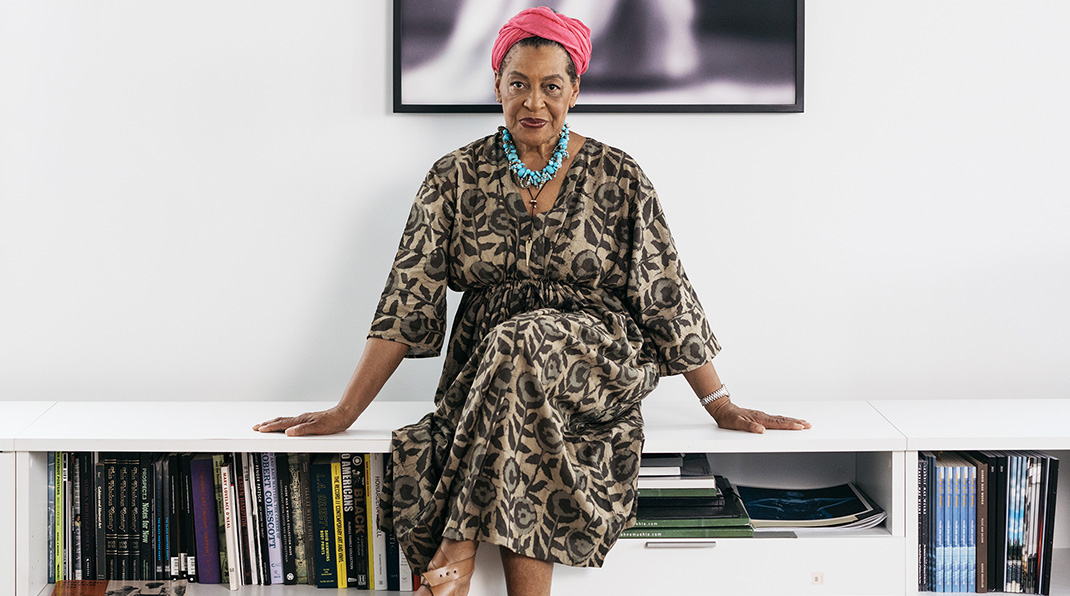
Carrie Mae Weems: A Syracuse Artist Steps Into the Spotlight
She has been recognized by two living U.S. presidents. The Smithsonian American Art Museum calls her ‘an icon, national treasure and genius’
By Mary Beth Roach
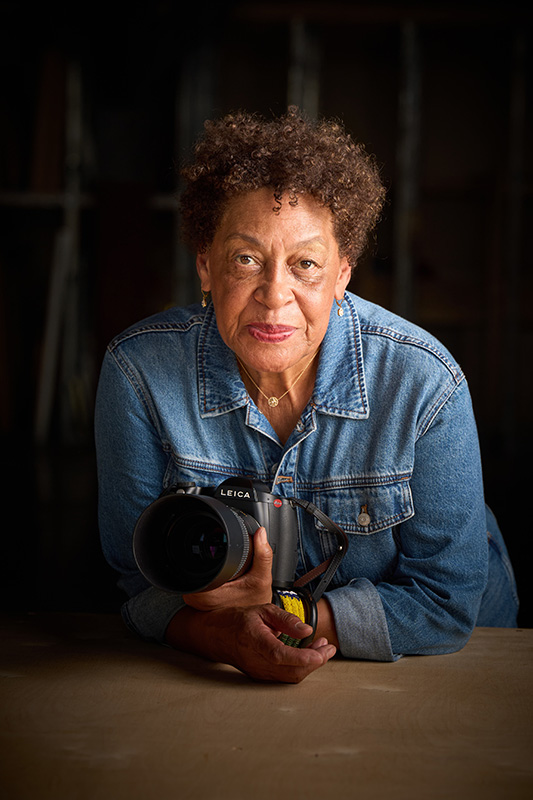 When Carrie Mae Weems was gifted a camera for her 20th birthday, she never imagined it could launch a career that would span 50-plus years or that her art would be shown in museums and other arts institutions throughout the country and abroad.
Weems, 73, certainly hadn’t imagined that her work would be recognized by not one but two U.S. presidents and become iconic in her field.
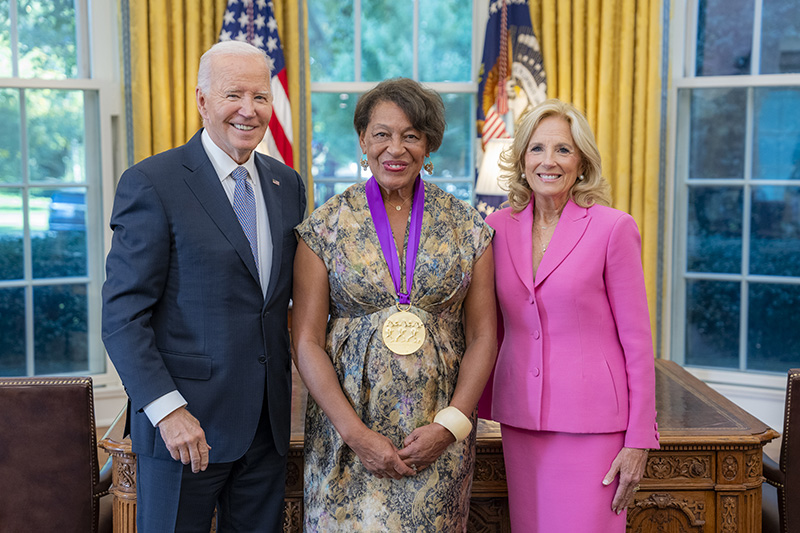
The Syracuse resident was among a select group of artists represented at the opening of the Obama Presidential Center in Chicago this past June. And in 2024, she received the National Medal of Arts from President Joseph R. Biden Jr. at a White House ceremony. She was the first African-American female visual artist to be recognized since the honor was first awarded in 1985.
“I was completely blown away. Very, very, very grateful,” she said, but yet she was stunned that she was the first African-American woman to be receive this honor.
“I get a chance to, once again, represent and to be able to mark this moment of change and understanding and awareness,” she said.
She found the Bidens to be gracious and warm, and while she admitted to being a little nervous at first, she said her husband, Jeffrey Hoone, was able to break the ice, talking about the mutual friend that he and Biden have in the Syracuse area.
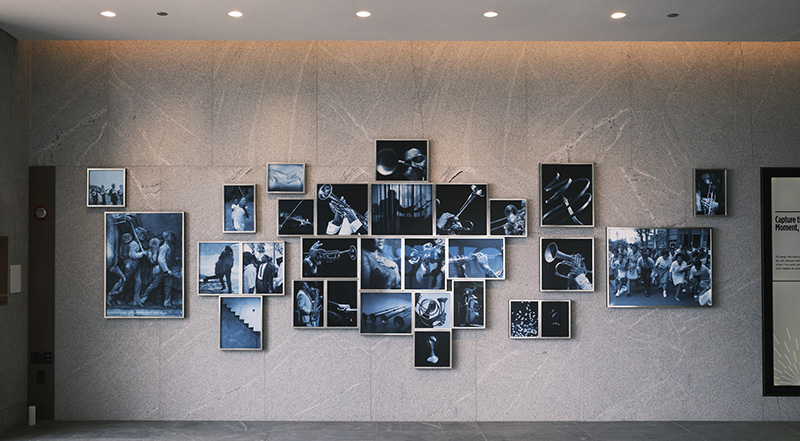
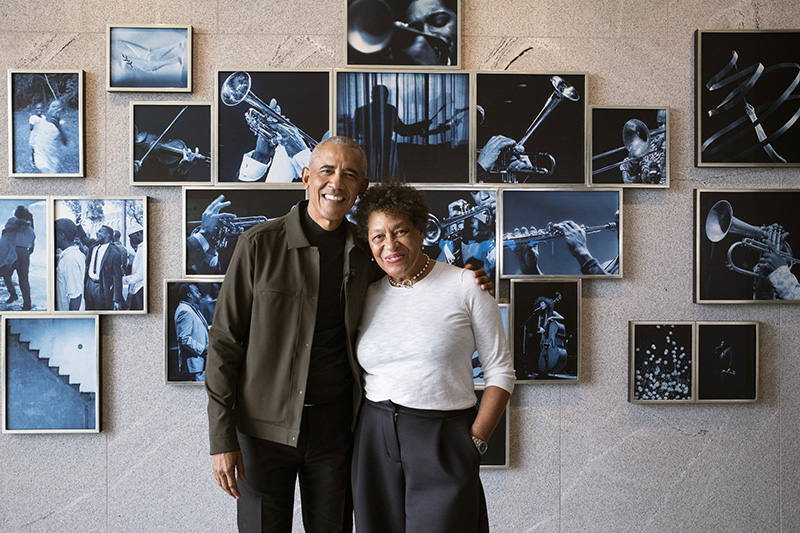
About her work at the Obama Center, a press release from Obama.org, noted that her piece, titled “The Cool Blue Wind,” “is a photographic collage printed on silver and gold metallic paper with blue tonal overlays, accompanied by original music, presented in the museum building. The images reference President Obama’s historic win and the freedom found in the organized improvisational nature of jazz. The associated soundtrack, which will be accessible to the public, centers on jazz, collective memory, and democratic participation.”
Having been selected to have her work at the center, she said, “is the opportunity of a lifetime, the commission of a lifetime. I never imagined anything like that.”
And it all started with a camera, which would help to bring her passion into focus.
She said, she “just kind of took to it immediately. It just felt very much like a tool that would allow me to explore the world in a really unique way. And in the moment, I had a camera in my hand, I simply had the sense of what I might be able to do with it.”
And what she has done with it!
She is the first Black woman to have a retrospective at the Guggenheim Museum. Her pieces have been in public and private collections, including the Metropolitan Museum of Art; Tate Modern, London; Whitney Museum of American Art; National Gallery of Canada; Museum of Contemporary Art, Los Angeles; and the Smithsonian American Art Museum, which has referred to her as “an icon, national treasure and genius.”
As a Black woman growing up in the tumultuous decades of the 1960s and ‘70s, Weems’ life experiences have been instrumental in shaping her work as a multimedia artist and she has used photography, along with text, music and video, to, as she said, “look deeply at the society and its social structure.”
“The one thing I knew was that I wanted to make a difference in the world somehow, not simply making a ‘mark’ for myself, really making a difference in the world. I thought that the world could be a better place and that social justice was important and that discrimination was unfair,” she said.
She remembers returning from school one day to find her mother in tears at the news of President John F. Kennedy’s assassination. She recalls going on drives with her father and having him ask her to read Martin Luther King’s “I Have a Dream” speech over and over to him and she believes then as now that he wanted her to read it as much for him as for her. She explained that he didn’t tell her to simply read it on her own, but instead asked her to read it to him, allowing the two of them to share the experience.
 “I am profoundly grateful to a family that instilled very early in my life that I had a right, that I had a right to be, that I had a right to question, that I had a right to explore, that I had a right to be in the world. That I had a right to be in any room, that there was no one better than me, but I was also no better than anyone else,” she said.
She also knew, she said, that by looking at what others had done and were trying to do, regardless of their race or ethnicity, people “were really trying to figure out how to participate and to illuminate the world. And I wanted to be a part of that.”
Weems’ photography tells stories by creating or recreating images, bringing her artistic expressions to the images. For example, in 2008, while an artist-in-residence at Savannah College of Art and Design, she developed “Constructing History,” a series of photographs that involved students and community members to reimagine those assassinations and significant moments of the 1960s and other eras.
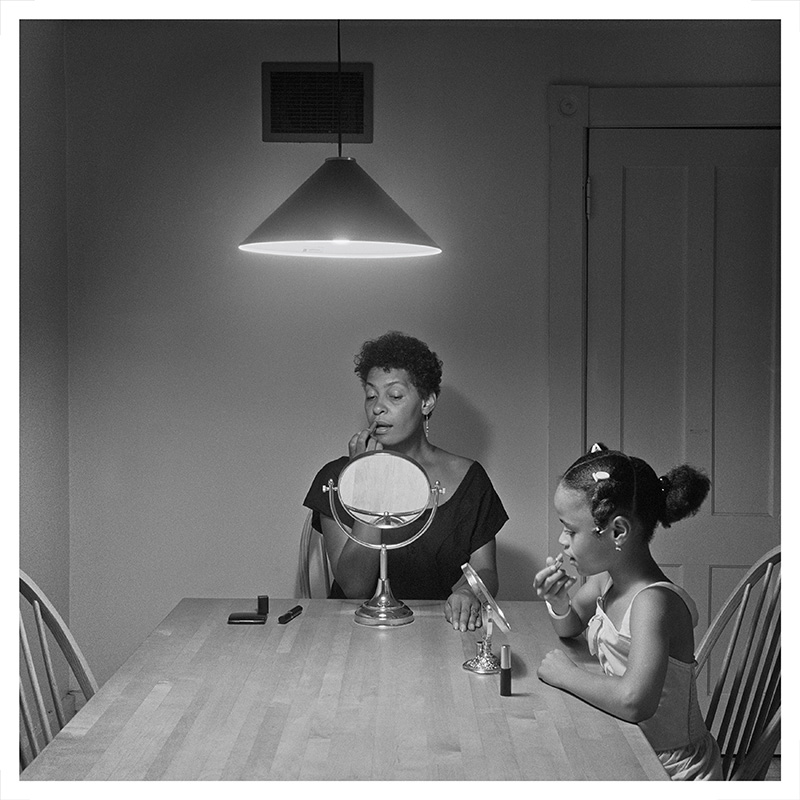
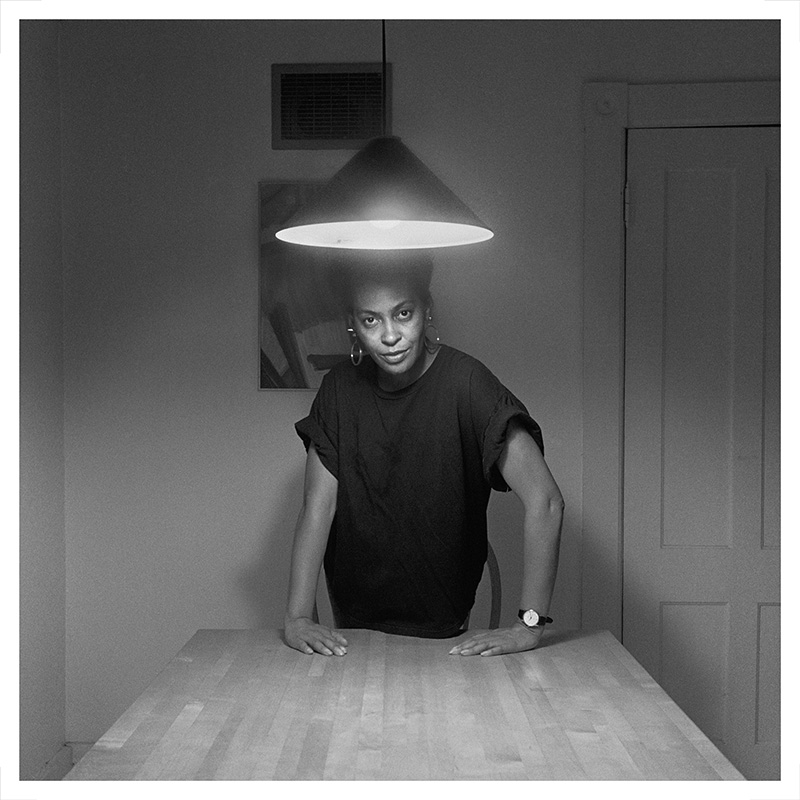
Of her immense body of work, she sees her “Kitchen Table Series” from 1990 as her hallmark.
It’s very powerful in its black-and-white unembellished setting. Each of the 20 photos shows the same woman, actually Weems herself, at or near a kitchen table, with a single light fixture suspended overhead. Sometimes, she is shown alone, sometimes with a lover, sometimes with a child, sometimes with friends. Accompanying the photos are text sheets that tell a story.
As Weems explained, the series is about how we, as individuals, “struggle with the question of love, of domesticity, of who has a right to act and how will they act in the world.”
“[It] has been such an enormously important work, not only for me, but for my audience and for the general public. It’s a work that’s constantly being cited. It’s a work that is constantly referenced. It’s a work that hundreds, maybe thousands of young people have attempted to emulate,” she said.
The vast majority of her work, she believes, is centered around power and the various ways it manifests itself. As she explained, her work tries to explore who has power and who doesn’t, what it means to have a certain kind of power and what are the consequences of the abuse of power.
“I’m looking constantly at this question of power and equity and equality and how it is dealt with over time in a variety of different ways,” she said.
Her greatest influence, she said, is music.
“I think of music as being perhaps like the highest form of artistic expression amongst humans. There’s something powerful about the human voice in all of its articulation, whether it’s through storytelling or through singing or through speaking and so I’ve really been relied on music and literature as a gateway into exploring these deeper ideas visually,” she said.
Over the years, her creative nature has led her to go beyond photography; she is also a producer of conferences and convenings of other artists and performance work, making videos and films. For her, she said, it allows her to continue to be engaged “with the world.”
And over the years, too, she has evolved as an artist.
“When you’re younger, you’re so sure. And when you’re older, you’re not,” she said. “It means that you become humble. I’m probably more humble at 72 than I was at 50 or when I was 30. I’m willing to explore more of the gray zone. Things are not necessarily binary. Life is complex.”
These thoughts might be further underscored in her “Contested Sites of Memory,” which was shown at the Lincoln Center in late January, and featured monuments, including those considered Confederate. The Lincoln Center work was intended to engage audiences through a collaboration of photos, video, music and spoken word.
“I completely understand why the Confederates would want to build monuments to the people that they admire. Probably at 30 I would probably say ‘take them all down,’” she said. “Now, “I might say, ‘No, leave them up and contextualize them.’ Because I begin to understand the flow of history differently. I have a certain level of compassion for those people, even as I disagree with them. To understand their positions, their ideas, even as I disagree. I’m willing to engage conversation and engage their questions and engage our differences.”
The installation further underscores Weems’ views of this country and democracy.
“I’m more interested in the multiplicity of voice and the U.S. is the place with many different voices. We would not be — and we cannot be — a unified nation unless we understand that it’s a multiple series of voices that make up the communities in which we live, the society in which we live. What we have to do, then, is come to terms with those differences, even as I disagree.”
On Meeting Barack Obama
To have a permanent art installation in the recently unveiled Obama Presidential Center in Chicago is a highlight for Carrie Mae Weems in a career that has spanned more than 50 years.
“It’s an honor and humbling,” she said. “I feel honored that not only am I allowed to show the world, but also that I’m allowed to carry my family name into the historical record. I only wish my father were alive.”
She is one of 30 artists invited to have her work featured at the center. The piece, “The Cool Blue Wind,” is a multi-media mix of photos of famous musicians from across generations, along with music Weems worked with other musicians and composers to create and she titled it “Obama Suite.” The images were created by her as well as other photographers.
It was during the installation of “The Cool Blue Wind” that Weems met former President Barack Obama.
“The president walked off the elevator and the first thing that he hears is the music and he said, ‘Oh my goodness, what is that?’ And I said, ‘Well, that’s the Obama Suite. I made that for you.’ He just gave me this big warm smile, this wonderful embrace, invited me to take photographs with him in front of the piece and then invited my installation team to be photographed with him,” she said.
She said that she and Obama discussed the piece and other projects she’s working on.
Weems further described the former president as warm, generous, kind, unassuming and “a phenomenal classy man.”
Later, during a party held for the participating artists, Weems said they were all able to take individual photos with both the president and Michelle Obama. She said she didn’t get a chance to talk to Michelle Obama, but “I danced the night away with her with RuPaul as the DJ of the party.”
Of the Obamas, Weems said, “the thing that is so lovely to see is the joy and the love in which they take in being with one another. They really do work together as a team, and I find it really remarkable.”
The Obamas were familiar with Weems’ work long before the center’s installation. One of Michelle Obama’s doctors happens to be a collector of Weems’ work and she gave Michelle Obama one of Weems’ photographs from the “Kitchen Table” series as a Christmas gift to The First Family when they were in the White House.
“The Cool Blue Wind” isn’t the only work Weems will have at the center. In creating this piece, she, together with an audio tech, developed her own audio speaker system, deciding on the image on the speaker, how it would function in the space. She said she is in talks right now about developing a set of speakers that will be presented and sold through the gift shop at the center.
While the art installation has certainly been a highlight for Weems, it is certainly not the finale.
“What I’ve learned as an artist is that if you’re paying attention to the work and you’re paying attention to the lessons of the work, it really does take you from one thing to the next,” she said.