
50 Years Helping People Overcome Addiction
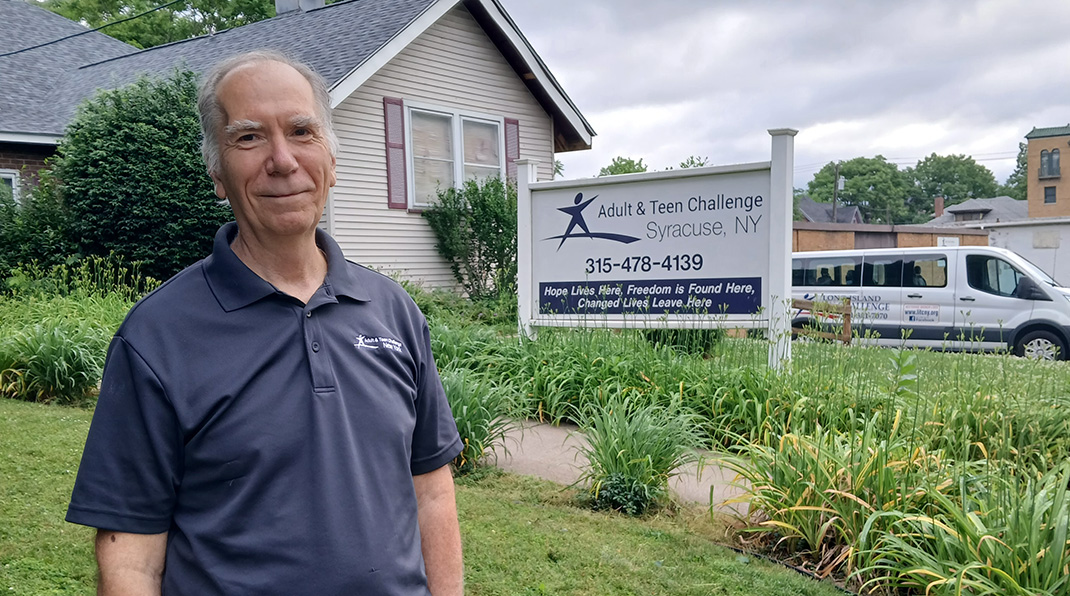
After 50 years with the Syracuse Adult and Teen Challenge — the last 41 as director — David Pilch is slowing down. He will now serve the nonprofit as a part-time campus pastor
By Tim Bennett
It takes a certain kind of person to work with or be in relationship with addicts for the long—term. Anyone who has had family members battling with life-controlling issues or tried to help an addict will attest to this fact.
Employment for addicts becomes virtually impossible, family relationships break down and criminal activity often results. In the worst-case scenarios, they live on the streets barely surviving or overdose and die.
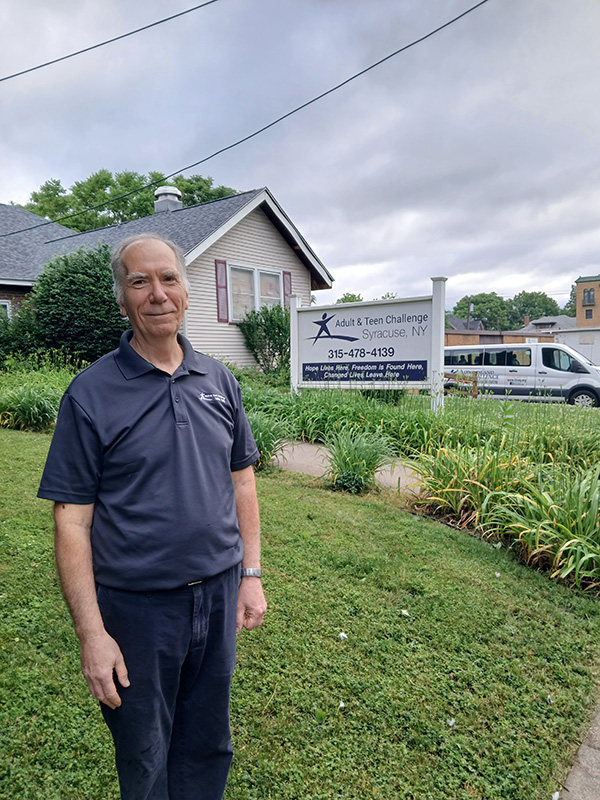
In a profession where rehab workers do not typically stay very long, David Pilch’s commitment to The Adult and Teen Challenge of Syracuse makes him a rare anomaly. He has been with the organization for 50 years — 41 of those years as a director.
Recently, I met with Pilch, a slender and soft-spoken man, in his office at the organization’s center on Furman Street in Syracuse. Even after relinquishing the director’s role at the center, he still works part-time as the “campus pastor,” answering calls, doing intakes, teaching or just doing what needs to be done.
In 2021, Pilch, 71, felt it was time to hand off the reins of the ministry to the new director, Rashad Hamdan, who is a graduate of the Long Island Adult and Teen Challenge Center and has been on staff since 2015.
The Syracuse Adult and Teen Challenge organization’s approach to addiction is what is called a “faith-based” rehabilitation program, which views addiction as a spiritual problem and seeks transformation through a higher power. It relies on scripture, prayer, biblical counseling, strong peer support and spiritual mentorship.
In 2024, according to a Syracuse.com report published April 25, 2025, 90 people died of opioid-related deaths in Onondaga County, with 81 of those being fentanyl-related.
Pilch talked about his half a century with the Adult and Teen Challenge ministry and how the infiltration and proliferation of fentanyl in our country has made reaching addicts more urgent than ever.
Q. How has the drug culture changed since you first started working for the Syracuse Adult and Teen Challenge in the ‘70s?
A. With fentanyl, addicts today are playing Russian roulette. It is really sad because you can save a guy, like what they reported in the newspaper three years ago. The Cicero police had found a guy slumped in his car in a parking lot. They gave him Narcan and saved his life, but two months later he overdosed again and there was no one around to help him. This should be a warning to everyone taking drugs, if you are revived once, you’d better take that as a warning to get help fast because the next time you may not be so lucky.
Many people have died in the last five years from fentanyl in the United States. In 2022, it hit 107,000. I learned recently that drug dealers are now putting fentanyl in marijuana and people are dying from marijuana use. It’s insane.
Q. How did you get involved with Teen Challenge or what has now become The Adult and Teen Challenge of Syracuse?
A. It was through the bestselling book, “The Cross and the Switchblade,” by David Wilkerson, which was eventually made into a movie with Pat Boone and Eric Estrada in 1970. I told my parents I wanted to see this movie, but it showed people shooting drugs so they said no. I was a junior at Christian Brothers Academy at the time. When I saw the book in the CBA library, I took it out.
Q. What attracted you to this movie and the book?
A. I found the title intriguing. When I read the book, I learned it was about a preacher who felt compelled by God to share the gospel with gang members in New York City. As I read the book, I found myself examining my own life. Where am I going? What am I doing? How am I living?
Q. Are you from a religious family?
A. Oh, yeah. We were Catholic and went to church all the time. But I didn’t really know the Bible. I went to Onondaga Community College after graduating from CBA and discovered there was a group doing Bible studies, so I joined. In “The Cross and the Switchblade” the author was always talking about the Bible and getting direction from it. So, I thought it was important to know it better. In the course of the study, I dedicated my life to Christ. At first, I thought that meant I was going to be a priest, but I talked with a priest on campus and he told me, “You’re young. Better to wait and see.”
Then I heard about this Bible school, Christ for the Nations, in Dallas, Texas. I wanted to go there after I graduated from OCC. At first, my paents were against me going because it wasn’t Catholic but eventually gave their blessing. I didn’t find out why my mom changed her mind until much later at a Teen Challenge banquet. My mom confided in the pastor at our table, while I was going around greeting people, that she had let me go to Bible college because one morning she had heard God’s voice saying, “Let him go.” When I returned to the table and the pastor told me what she had said, I was flabbergasted because for 40 years she had never told me anything. Immediately, I could see the double meaning in what she heard. Let me go to the school and also let me grow up and make my own choices.
Q. Was it at Christ for the Nations where you heard more about Teen Challenge?
A. Yes. I attended a regular prayer group with other New York state students at the college and one time we got a prayer request for a Teen Challenge director who had been beaten up by a gang. He later died but that experience had a profound effect on me. Then David Wilkerson, the founder of Teen Challenge, spoke powerfully at our graduation. When I returned home to Syracuse I saw an ad for a job near Furman Street in Syracuse. I went to apply for the job, but it had already been filled. As I walked to my car, I saw the Teen Challenge Center and I spontaneously decided to go in, introduce myself and volunteer my services.
Q. So, hearing about a Teen Challenge director getting beaten up and dying didn’t deter you from working there?
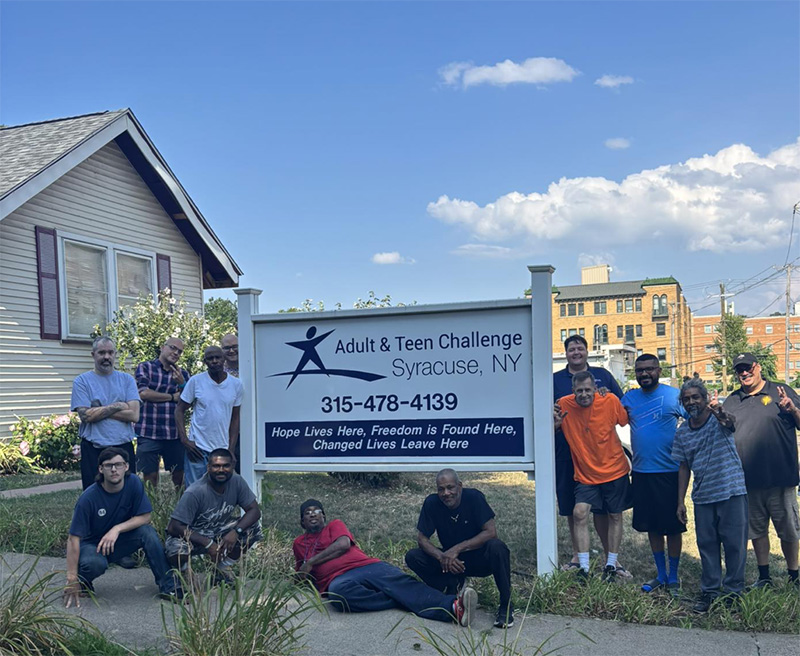
A. No. I just thought people needed to do this type of work, so why not me? I started as a volunteer in 1976 when I was 22. I helped work on the building. They had maybe three or four guys in the program at the time. There weren’t a lot of churches supporting us. By the end of the summer, I was asked to be the live-in staff member. The last guy who had my position had his car stolen by one of the residents who then ditched it in the harbor in Yonkers. He quit. I knew about what had happened, but I moved in anyway. It was a really difficult first year, but I got through it.
Q. How was that first year difficult for you?
A. The center closed down from lack of funding for a while and they asked me to stay there alone so it wouldn’t be trashed by some guys in the hood. Unfortunately, I came back to the center one Friday night and saw the light on in my room and my window broken. Then I saw two guys in my room. They saw me and grabbed some of my stuff and ran out the front door. They were never caught. After that, of course, I was a little jittery being there by myself so I kept a baseball bat near my bed.
Q. When did Teen Challenge Syracuse reopen?
A. We reopened in 1978 and the national Teen Challenge organization got involved. Rochester already had a strong operation and Buffalo also wanted to open up a center so they decided to open up officially as the Empire State Teen Challenge, which combined all three cities. I became the supervisor and at 24 I was in charge of the Syracuse center.
Q. What are some of the things that you teach the men as part of your program at the Adult and Teen Challenge center?
A. Anger is one of the big issues with addicts, so we focus on our personal rights and the need to surrender those rights to God. We challenge them to ask Christ to be in charge of their lives. It goes back to: who is on the throne of your life? I remember seeing a gospel tract by Campus Crusade for Christ when I was at OCC. It had a picture of a throne with the question underneath it, who is on the throne of your life? I knew right away, when I first saw it, that I was on the throne of my life. I always did what I wanted to do without considering what Christ wanted me to do. And that’s not what it means to be a Christian.
Another issue addicts deal with is the pain they have, maybe from rejection or things they feel guilty about or from loneliness or depression. So, they start self-medicating. What they are seeking is joy and peace, which is what you find when you receive Christ into your life.
Q. What is it that makes your type of program so successful?
A. It gives addicts hope because all our staff are graduates of the program, except me. But I have been going through the program for 50 years now. We’ve seen many people get free so we can sow faith into the guys when they want to quit. The graduates can tell them: “I did it. You can, too. Don’t quit. Let’s pray together.”
We use the national curriculum and it covers things like rebellion and how to deal with authority figures. Most of these guys have had problems with authority. They’ve gotten in trouble at school, with the law and maybe spent time in jail. We rebuild their foundation with truth. We teach them how to forgive and love others, which may start with loving their brothers in the program.
Q. Addicts are not known to be people who are easy to get along with. Did you ever think of quitting?
A. I’ve had some thoughts about quitting over the years, but I don’t think I ever seriously considered leaving. I have always felt this is where I’m supposed to be. I have been disappointed at times, of course, but I have been careful not to let it turn into discouragement. In fact, many times when I would be disappointed about something, somebody who graduated from our program, maybe five or 10 years ago, would call and say, “Remember me ? I am still doing well and I have kids now.” Things like that keep me going because that tells me what I am doing is changing people’s lives and that’s what I’ve always wanted — a life that makes a difference.