
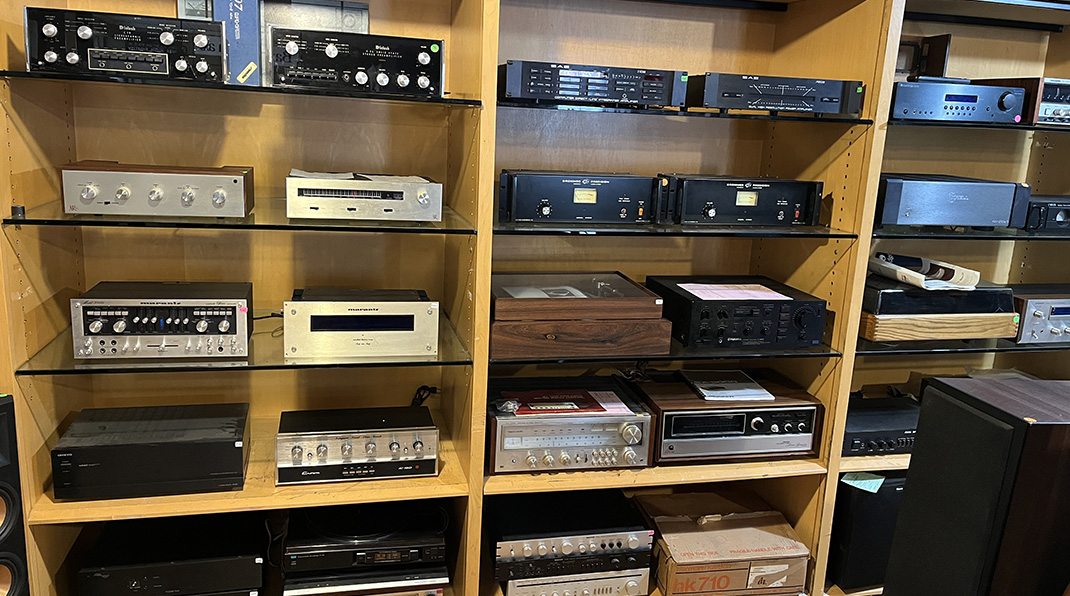
Celebrating HiFi Music
A shop in Jamesville has developed a cult-like following among people passionate about high fidelity stereo equipment and music
By Aaron Gifford
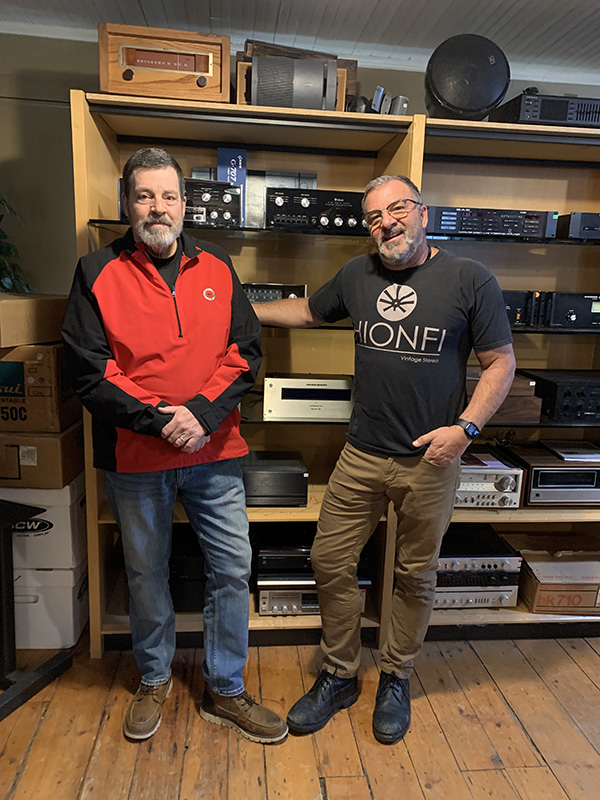
If it weren’t for folks 55 and up, HIONFI vintage stereo equipment might have been dead on arrival.
The Jamesville shop, with a cult-like following, has proven to be a successful business for 15 years now.
It has also functioned as a museum of sorts and a gathering place for a generation of music listeners longing to return to that personal connection social media and streaming services just can’t provide.
“We couldn’t do it without them, that’s for sure,” said co-owner Bill Mosher. “They’re not just our customers, but also our suppliers. They go into their basements and then sell us these beautiful stereos. If it wasn’t for downsizing, we wouldn’t be here.”
Mosher and co-owner Rod Littler took some time recently to talk about the roots of the shop, their Central New York connections and the vinyl revival championed by older adults.
Rewind, or drop the needle back, a couple of decades.
Littler was in the printing industry, while Mosher worked in advertising and marketing, including jobs with the Greater Syracuse Chamber of Commerce. The two Central New York natives, too young to retire then but now both in their 60s, became business associates and friends, often discussing their vision for a store and service that “does what it’s supposed to do,” Littler said.
They also knew that baby boomers in this region made up a huge customer base; they had more time and disposable income.
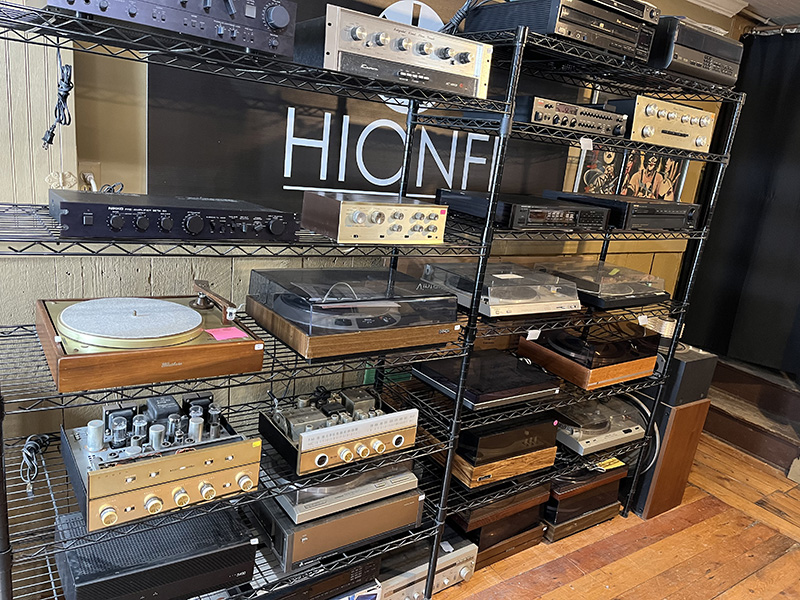
Moreover, folks who grew up in the 1960s and 1970s wanted to listen to the music they used to love in the same way they listened to it decades ago and those who couldn’t afford the music and the machines as youngsters finally have the money to buy what they always wanted, Mosher said.
Both could relate: Littler, who grew up in Camden, near Oneida Lake, was in high school when everyone loved the Allman Brothers. Mosher, raised in the Syracuse suburbs, was also an Allman Brothers and Grateful Dead fan. Littler gravitated toward rock fusion music like Steely Dan and later became a jazz fan. Mosher developed a deeper appreciation for the variations of rock music, from southern rock and jam bands to some of the pop-rock combos that dominated the charts into the 1980s. High-fidelity stereo equipment helped them expand their horizons.
Littler began buying and selling turntables and other components out of his home, just for fun. It became a profitable hobby that demanded more time and space.
“People liked the gear, there seemed to be a buzz about it and it rapidly grew,” he said.
Mosher came on board as that business took off. They rented space in the old Shoppingtown Mall in DeWitt. Other than a few ads narrated by legendary Syracuse radio DJ Dave Fresina on a short-lived rock station around the time the business was starting, HIONFI then and now, was marketed mainly by word of mouth.
“If you do right by people, they’ll do right by you and tell others,” Mosher said.
When Shoppingtown closed, the shop moved to a scenic location near the main corner in Jamesville.
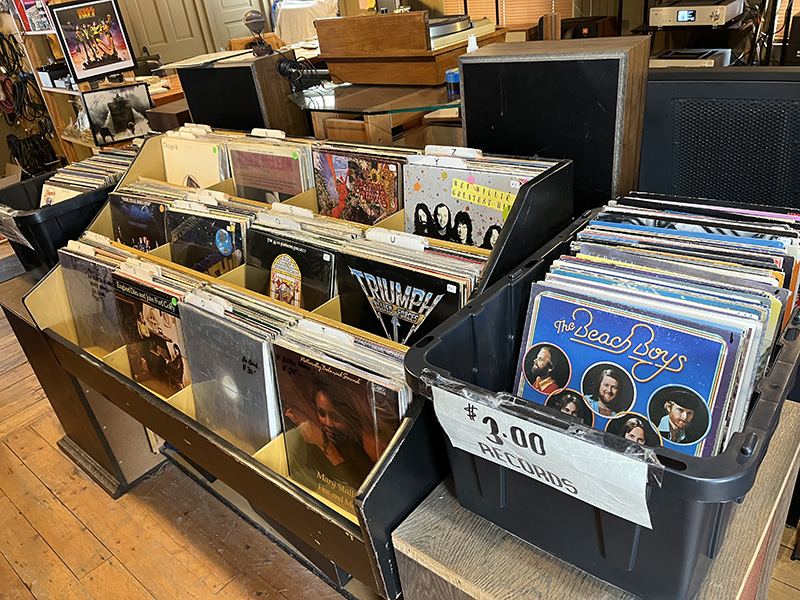
In addition to stereo equipment, Littler and Mosher also buy and sell records and handle repair service requests that they farm out to local technicians in the region.
“Back in the day, it was built well and built to be repaired,” Mosher said, pointing to some Pioneer amplifiers from the 1970s and 1980s.
They’ve sold and handled service orders for equipment dating back 60 or 70 years, including a large, heavy oak wooden radio unit that probably once was the centerpiece of a family’s living room before television was commonplace.
Not every item in the store is considered vintage. They recently sold a 2014 McIntosh amplifier for about $4,000 and on any given day, the shop has a variety of gear spanning several decades.
The McIntosh factory, still based in Binghamton, opened in 1949. The company handcrafts home and automotive audio systems — amplifiers, receivers, tuners, speakers, CD players, turntables, subwoofers and even wireless products, according to the company website.
“Since our inception, McIntosh has been powering some of the most important moments in music history and pop culture,” the website says. “From President Lyndon Johnson’s inauguration speech to Woodstock to the famous Grateful Dead ‘Wall of Sound,’ McIntosh has not only witnessed history, we have shaped it.”
The Wall of Sound was a tower of 600 speakers powered by McIntosh amplifiers delivering nearly 29,000 watts of power. The Grateful Dead used this system at several venues while touring in 1974. It was very advanced for its time, providing the band’s bass player, the late Phil Lesh, with a dedicated channel and speaker for each string on his guitar. It was a prototype that empowered bands to solve distortion problems that plagued live performances and gave musicians a better way to hear themselves play.
High fidelity is defined as the reproduction of sound with little distortion or change from its original form.
Littler and Mosher said they often refer to McIntosh as the “BMW” of hi-fi amplifiers and receivers, but that doesn’t necessarily mean everything made by that company is superior to all other brands.
Younger customers
They see plenty of people their age at the shop and lately there’s been more college-aged shoppers. Regulars in their 30s and 40s are still somewhat rare. While music fans of all ages enjoy the vastness and versatility that online streaming services have to offer, customers who visit HIONFI often complain that digital music seems to be missing something or that it just doesn’t compare to what they’ve heard through an analog system, usually on vinyl records, Littler said.
“Digital is binary information, zeros and ones,” Mosher added. “With analog, you cross the spectrum of harmonics. There’s more information to hear.”
Still, he cautioned: “It doesn’t matter what it sounds like to you or me. What you like, you like.”
Littler added, “even more exciting is they actually notice a difference in the sound, going from a compressed file they’re listening to in Ear Buds to actually hearing a piece of vinyl played on a turntable to an analog system. They can recognize the difference and they’re excited about it.”
The spectrum of stereo equipment, analog and digital, is vast, both in terms of price and quality. Plenty of very high-priced new amplifiers, receivers and speakers are made as well or better than components of the past, but there’s also name-brand merchandise, recent or vintage, that’s made cheaply and provides poor sound quality. Littler and Mosher say they are not there to push certain brands or the highest-priced items; they mainly just answer questions and hope customers have a great experience at their store.
Vinyl records constitute a small slice of the store’s overall business, but the co-owners cherish watching customers leave the store smiling with a stack of old records in hand, bought for just a few bucks.
“What we’re trying to give people is the ability to come in and say, ‘ Oh my gosh, I haven’t heard this album in years. I thought I lost it. Here it is. I have it again!’ “Mosher said.
On any given day, old timers and young families alike come in to look at the vintage gear, learn about it and hear it, even though they aren’t thinking of purchasing at the time. Likewise, regular customers stop in just to talk shop. Stories about the local music scene, legendary performers who played in Salt City and nearby venues and tall tales of hi-fi stereo legend are abundant. Littler once recognized an old friend he hadn’t seen in 30 years.
“It really is kind of like a museum here sometimes,” he said, laughing.
When he’s not working, Littler enjoys golf and gardening and looks forward to spending more time with his new grandchild.
Mosher sings for the Horn Dogs, a local party band that performs rock, funk, disco and Motown music throughout Upstate New York.
Reflecting on a history of hard work and the hi-fi craze that is a revival yet still an evolving era, the co-owners say it’s amazing how sometimes life imitates music or vice versa.
“Every step toward convenience,” Mosher said, “is a step away from fidelity.”