No Time Like the Present (and the Past) for a Good Mystery
Book by a Liverpool-based mystery writer wins prestigious nomination
By Stefan Yablonski
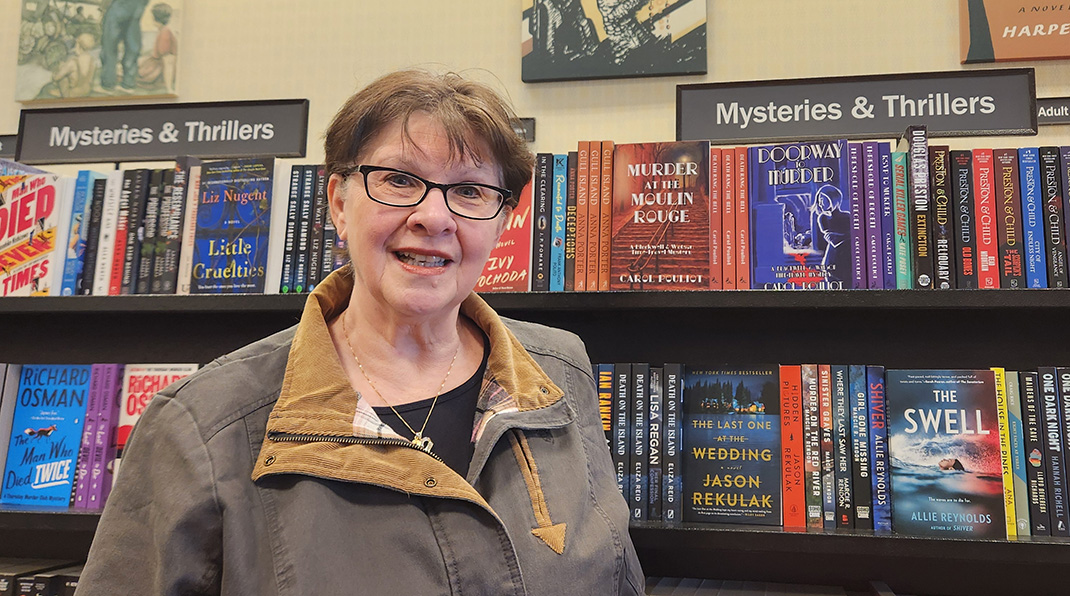
 Carol Pouliot holds a bachelor’s degree in French and Spanish and a master’s in French. She has taught French, Spanish, German and English. She also owned and operated an agency that provided translations in more than 24 languages.
Despite her busy schedule, she has managed to find time to write a few novels — five, to be exact.
The 75-year-old Liverpool resident is the author of the “Blackwell & Watson Time-Travel Mysteries” featuring 1930s Detective Sergeant Steven Blackwell and present-day journalist and researcher Olivia Watson. They share the same house in a small New York town — 80 years apart!
“My books are traditional police procedurals with a time-travel twist. They’re known for their fast pacing, unexpected twists and turns, meticulous historical detail, rich atmosphere and multi-layered plots. ‘RSVP to Murder’ has been compared to Agatha Christie, which thrilled me to death!” she said.
One of her books in the series gained recognition.
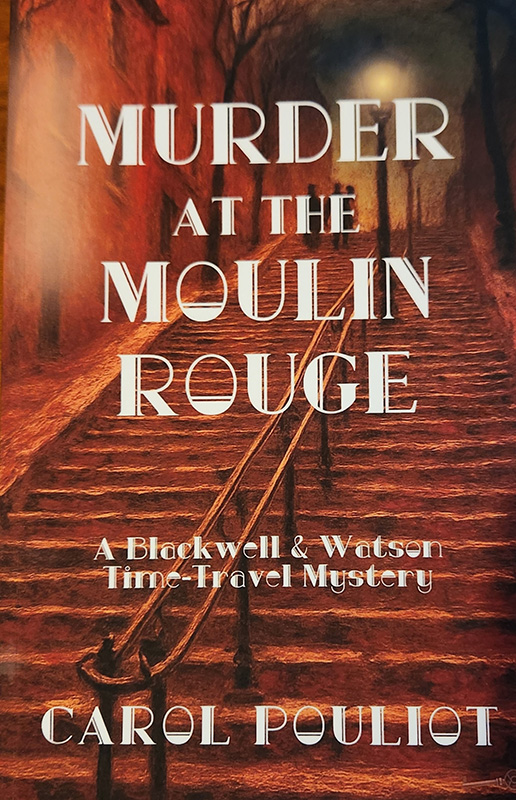
“‘Murder at the Moulin Rouge’ was just nominated for an Agatha for Best Historical Mystery in 2025!” she said. “As I imagine you know, the Agathas are the Golden Globes of mystery novel awards. I never ever expected this. I’m so excited!”
She is a former educator who student taught French, Spanish and German at the campus school when she was attending SUNY Oswego. Then she taught freshman and sophomore French at SUNY Stony Brook for a year and taught English at Lycée Montgrand, Marseille, in France, for a year. Later she taught French and Spanish at Onondaga Central High School, then at Solvay High School for 32 years.
A fan of mysteries
Pouliot — like Poirot, the “t” is silent — has always loved mysteries. “So, I put time travel as the core with a mystery wrapped around it,” she said. “My latest book [Murder at the Moulin Rouge] just came out at the end of September, first of October. What I typically do is I don’t start writing the next book right away. I focus on marketing for a few months and I just start thinking about the next book.”
It usually takes her two years to write it, she added.
“I think about it for a year, I build the characters and make up all the different elements. I keep it all in my mind. Once I can see most of the story — I don’t know who the killer is going to be until I am writing it — then I sit down and start writing,” she said.
She said she’d start writing her sixth book probably in late winter, early spring. She uses her phone as a recorder. When she gets different ideas, it’s easier to record rather than grab paper and pencil, she said. She’ll compose an email to herself and just leave it in the drafts.
Plotter or (seat-of-the) pantser style?
“When I started writing I was a plotter. I outlined everything in a lot of detail. But I noticed that when I got about halfway, maybe two-thirds of the way through, I abandoned my outline and just went for it,” she said. “A couple years ago I had knee replacement and I had swelling and trouble, wasn’t able to sit at the computer for four months. So that robbed me of the time that I would have been outlining. When I could sit down at the computer again, I just sat down and just started writing. And I love doing it that way so that is what I do now.”
She knew she wanted to write a mystery “but there are so many hundreds and thousands of mysteries out there. I wanted to stand out in some way, write something a little bit different,” she said.
She accidentally stumbled on an article online about Einstein. One of his theories was that there is no such thing as past, present or future.
“He believed that all time happens at the same time and he thought time could fold over on itself. When I saw that I thought I can write a dual timeline series on historical mostly police procedural. That really struck me and that was when I decided to do this,” she said. “I’d been retired from teaching for five years and I felt like I needed a mental challenge — a real good solid one because teaching every day is a lot of mental exercise.”
At the time, she had a subscription to Victoria magazine. In each issue they had a feature called Chimes — a memoir.
“I had a really nice memory that I liked very, very much sort of knocking around in my mind. It was from when I was 15 years old. My mother took my sister and me back–to–school shopping and I had money to spend from some summer jobs that I had done. We went to Addis; it’s Syracuse’s answer to Sachs Fifth Avenue. It was a very special store and I loved it. I used my money to buy a sweater to go back to school. It was such a magical experience for me that’s crystalized in my mind; it could have happened yesterday. I remember every detail,” she said.
She wrote the memoir and submitted it to one of the editors at Victoria magazine.
“She called me the next morning and she said, ‘we’d like to buy this, can you send more?’ I said sure! I wrote another and they put it in their Christmas issue the following year,” Pouliot said.
Two things happened.
“One, when I sat down to write, I had an extremely deep and profound feeling of satisfaction just wash over me. I loved the experience of creating this story,” she said. “The magazine articles were only 700 words each, so that didn’t take a lot of time.
“So, I thought, you know I have been thinking about writing a book for a long time. I am just going to go for it.”
Then she started planning her series.
Finding a publisher is very hard. It took her five years to get the first book polished so it was ready. At the time she was taking care of her parents who were both very sick.
“I didn’t have a lot of extra time to do the whole query process trying to find an agent or an editor. I did a little bit of that, but I found it to be extremely frustrating because these people have notes on their websites saying, ‘if you don’t hear from us for nine months or a year consider it a pass.’ So, I’m supposed to sit around for nine months or a year, really? I was already 65 and I didn’t want to wait for a year for somebody to say, ‘no thank you,’” she said.
During that time, she met a woman who co-owned an authors’ co-op. She submitted the manuscript to them and they accepted it. They published the first edition of the first book.
“I am glad I went that route. It was like taking a course in publishing; it was very good to learn from the ground up. They provided a lot of services. I had to pay for my own printing. The only thing I didn’t like was they didn’t have any distribution. I knew for the second book I wanted a traditional publisher. It took me about a year and a half and I found the publisher that I am still with. They offered a contract for three books,” she said.
A few months before the publication of a book, she begins promoting it and continues promoting it for several more months after publication, she said.
As she reaches the end of revising—editing—writing a book, she is already starting to think about the next one.
“All total, I take approximately one year to create the characters, plot, victim, suspects’ motives. When it’s clear in my mind, I sit down to write,” she said. “At that point, it will take another 10 months before I send it to my editor. I suppose this is a combination of plotter—pantser.”
New Books in the Works. How Does Author Get Her Ideas?
Carol Pouliot of Liverpool has written five books and is in the process of publishing her sixth.
Where does she get inspiration for all her books?
“Anywhere and everywhere. I honestly don’t know. I will think of one small thing and then it seems to blossom,” she said. “After the second book came out and I felt more confident. I decided to challenge myself with each subsequent book. The challenges, I think, led to a lot of the storylines. I get one small idea and it just blossoms.”
“I don’t know if the characters ‘talk’ to me, but they seem real to me. They are in my mind all the time. I am always thinking about them,” she continued. “The first thing that I do before anything at all with every single book, I create the characters. I’m not talking about physical description or where they work. I am talking about their deepest fears and greatest desires, their full history, work history, school history, friends, family, romantic partners, when their birthday is, favorite food — the whole thing.
“Once I start writing I kind of let these characters go and as long as they are following the psychology and personality of the character traits that I set up, then they do certain things. That is a lot of fun because I never know who the killer is going to be.”
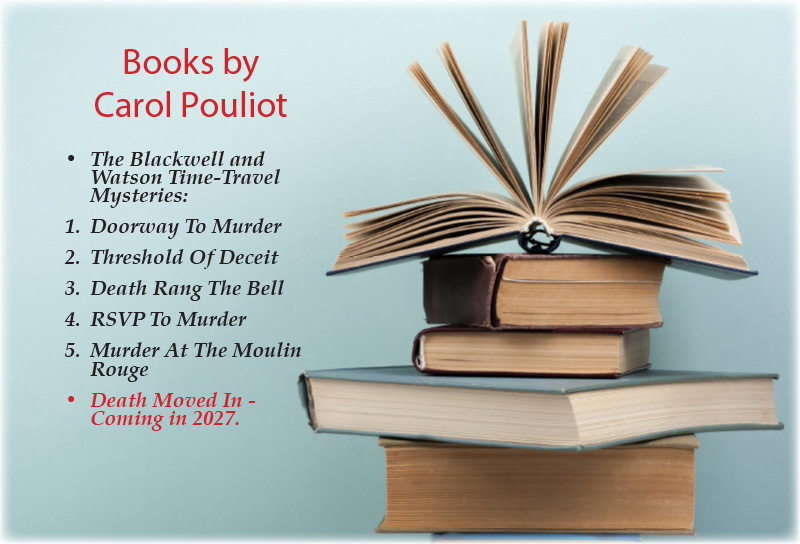
She said she has been thinking about a book six for about 10 months or so. Book six is titled “Death Moved In” and will be published in September 2027.
“I have a few ideas [for new series] but I am not sure yet. I’ll sit down sometime in the early spring and start typing it. Then I’ll write it a dozen times (chuckles) and by the following March, I will be able to send off my best effort to my publisher,” she said.