

Celebrate America’s Semiquincentennial Your Way
By Michele Bazan Reed | bazanreed@hotmail.com
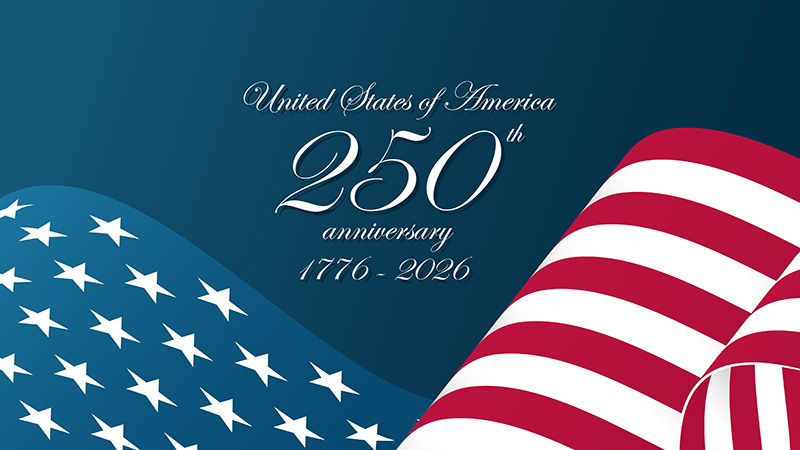 Most of us reading this magazine have had at least 55 birthday celebrations. But on July 4 this year, everyone in these United States can have a cake with a few more candles — to celebrate the United States’ semiquincentennial or 250th birthday.
There are big doings planned in Washington, D.C., and cities around the U.S.A. We’ll no doubt see plenty of concerts, fireworks displays and art exhibitions. Lots of souvenirs, too, from keychains, mugs and mini flags to gold coins and limited-edition collectibles.
Some of us can remember the country’s bicentennial in 1976. America had just come through a turbulent era in the 1960s and ’70s. The Vietnam War, student protests and the Watergate scandal divided Americans along ideological and generational lines.
The bicentennial celebrations were designed to foster pride in our shared heritage and bring all Americans together in celebration. And did they ever!
Whose heart could fail to thrill at the sight of Operation Sail, with tall ships from around the world sailing into New York harbor? Or July 4 fireworks bursting in the night sky above the Statue of Liberty and a wagon train, crossing the country from the West Coast to Valley Forge?
Queen Elizabeth II and Prince Philip visited the former colonies to commemorate the bicentennial. They presented the United States with a replica of the original Liberty Bell made by the same British factory that forged the original.
Red, white and blue were everywhere — and not just on Old Glory. The Empire State Building and other landmarks lit up in red, white and blue lights. Soda cans, candy bars and cereal boxes got new patriotic labels. And people young and old sported the country’s colors in their clothing. My daughter collects vintage clothing and sewing patterns and many from 1975-76 feature red, white and blue motifs or colonial design elements.
Signs of patriotism were everywhere, and ordinary Americans got in the spirit. My father worked at the Mohawk Carpets mill in Amsterdam, and the company made a bicentennial rug featuring an eagle and the Liberty Bell. He told us one was presented to President Gerald Ford and others to state and local officials, as well as for sale to the public. He gifted one to me and Bill, then newlyweds, for our first apartment.
My mother loved to crochet and she made a red, white and blue granny square afghan. Even I decided to try my hand at an authentic colonial craft and planned a pinwheel pattern quilt in red, white and blue, all hand pieced and sewn. But I underestimated how time-consuming it would be. After what seemed like weeks of work, I got realistic and finished two throw pillows that graced our home for many years.
So, this year, I’m looking for activities that can once again bring our nation’s history alive in a tangible way. I challenge you to try it, too. With 250 years of history to choose from, there are any number of ways to make it real.
I know myself better now and I’ll never finish a quilt, or even a pair of pillows. I do love to embroider, so I think I’ll try candlewicking, embroidery featuring thick, white cotton thread on unbleached muslin, composed of simple colonial knots.
And since watercolor painting is my current passion, I’ll make like enthusiastic sketcher Ben Franklin and try to make some colonial-themed art.
Colonial era crafts would be great for getting into the historical moment — from quilling, rolling strips of paper to create intricate designs, to homemade soap and candles, woven fabric, baskets or carved wooden utensils.
Learn about these crafts and others like tinsmithing, leatherwork, African American quilt squares and bookbinding at Colonial Williamsburg’s website, https://shorturl.at/D71ed.
Plenty of other websites offer inspiration or check out resources from your local library or independent bookstore.
Arts and crafts are a great way to share the story of our history with grandkids, young neighbors and local schools.
So are colonial toys and games, like marbles, jackstraws or pick-up sticks, hoop and stick games or hopscotch.
Books for all ages portray life in Colonial America and the War for Independence. “The Great Rope” by Rosemary Nesbitt tells the story of a 12-year-old boy helping to carry a massive anchor cable for use in building ships on Lake Ontario for the War of 1812.
Your local library or bookstore can be a great source for recommendations for books about the colonial era, for young and old alike. Consider a good history book or historical novel as a fun, relaxing way to get in the mood to celebrate our nation’s birthday.
And since we’re celebrating the 250th anniversary of the signing of the Declaration of Independence, it’s fitting to read and reflect on this seminal document from our nation’s founding.
We’re fortunate to live in a region rich in sites important to the Revolutionary War. Fort Ontario in Oswego, Fort Brewerton and Fort Stanwix in Rome all played a role in the early history of our country.
One lesser-known site is Spy Island. My daughter, Katie, and I were exploring Mexico Point Park when we literally stumbled upon a sign celebrating Silas Towne, Revolutionary Hero. It seems young Silas was standing right where we were, when he heard British General Barry St. Leger discussing his plans to attack Fort Stanwix. Towne rushed to Rome with the news, giving General Nicholas Herkimer and his troops ample time to prepare for the attack and defeat the British in the Battle of Oriskany.
So, whether you decide to explore some battlefields, try your hand at colonial crafts, read a history book or just enjoy an extra hot dog while watching the fireworks, I hope you have a great Semiquincentennial celebration.