

War: What Is It Good For?
By Marvin Druger | mdruger@syr.edu
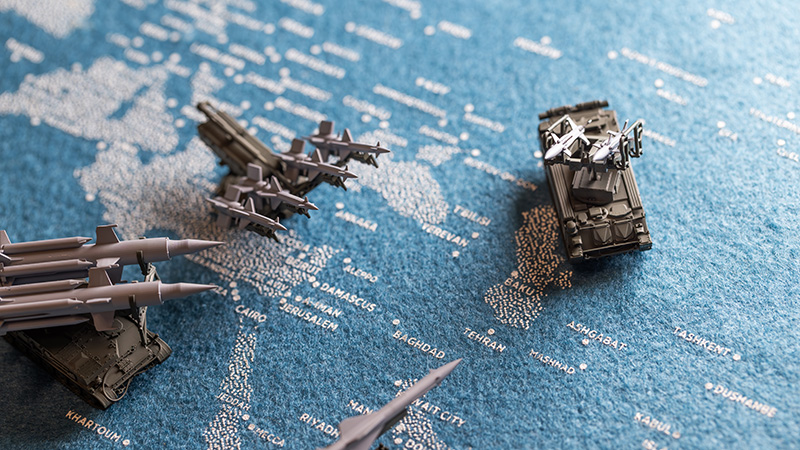 The history of humanity involves wars from the very beginning. Humans are social animals and tend to live in groups. These groups are often culturally and geographically diverse. Each group has claim to its own territory and will defend it when necessary. The different groups develop different leadership. No matter what form of government exists, there are always key individuals who assume leadership roles.
An extreme example was Adolf Hitler.
He had very humble beginnings, being born in a small town in Austria. His father was a state customs official. His mother died when he was about 18 years old. He moved to Vienna and had ambitions to be an artist. He was rejected twice by the Academy of Fine Arts in Vienna due to insufficient artistic talent. He served in World War I and earned commendations for his heroism. Despite his lowly status in society, he rose to be one of the most powerful and vicious leaders in history. He served time in prison for insurrection activities and wrote a popular book, Mein Kampf (My Struggle). He was responsible for World War II and for murdering millions of people, including an estimated six million Jews. Hitler died by suicide in 1945 at age 56.
I often wonder how an individual with such an insignificant background could have risen to political heights that could not be surpassed. Germany adored Hitler and followed his will in warfare and murder.
Hitler was not the only war-mongering political leader in the history of humans. Indeed, Ramses I, was pharaoh of Egypt for 66 years and was involved in 15 nasty wars.
The U.S. has had its share of warfare, i.e., world wars I and II, the Vietnam war, the Korean war, the Civil War, the War of 1812, the war in Iran and many others.
How can this happen?
Many years ago, I served as secretary and chair of the Education Section of the American Association for the Advancement of Science (AAAS). AAAS is the largest multidisciplinary science organization in the world. There are 24 sections in different disciplines that comprise the organization, including the education section. The sections periodically issue resolutions that have worldwide implications. One year, the anthropology section issued a resolution that “Humans are by nature warlike.” The statement was circulated to the other sections for their approval. The statement was voted down. My suspicion is that the resolution was voted down because if humankind was by nature warlike, there was no hope for the future.
I believe that most humans do not want wars. They want to live peacefully and as prosperously as possible. Wars are often fostered and generated by political leadership and political motives.
Also, wars come to an end and peace is eventually restored. World War II is a good example of the aftermath of wars. Germany and Japan were our worst enemies. Now, these countries are our friends and allies. If this is the ultimate outcome of wars, then why have them in the first place?
Hatred and prejudice are often propagandized by political leaders, not by your everyday people. Why should I want to go to war and get a medal for murdering an enemy who I don’t even know and who doesn’t want war either?
I wrote two poems that express my strong, anti-war sentiments:
The Day Before the Battle
I await the unknown,
Fearful thoughts appear,
Some persist and others slip away,
Is there a ray of sunshine,
Or is darkness inevitable?
The unknown is worse than the known,
I imagine the battle,
Blood will flow on both sides,
Brother killing brother,
Emotions overshadowing reason,
Tomorrow I will be part of the play,
My mind can tell the sane from the insane,
But I am bound by politics and honor
And forced hatred and learned prejudice,
There will be no victory for either side,
I will be immersed in a cauldron of fire,
But I will not let the fire destroy me,
The flames will go out
Eventually.
The Endless Battle
Blood and tears intermingled on the battlefield,
Young friends lay dying and gasping for air,
Yet the sun shone brightly,
Indifferent to the carnage below,
Trees and flowers were in abundance,
Green grass was covered by scarlet spots,
“Charge!” came the command,
I asked myself “Why?”
Faceless men were not my enemy,
But I moved forward and cursed the world,
I caused meaningless deaths,
Unique lives were lost,
Yet the sun still shone brightly
And the flowers bloomed,
Will the battle ever end?
Can we prevent wars? If so, how?
Wars rely upon propaganda. Leaders and political factions promote hatred, suspicion and prejudices. Joseph Goebbels was a master at Nazi propaganda techniques in World War II. People are told to hate an “enemy.” We become convinced that they pose a threat to our security and well-being, even if there really is no threat. People need to be alert and reactive to such propaganda and recognize the true situation.
Misunderstandings can usually be negotiated and resolved peacefully. Benevolent, perceptive leadership is needed. Prejudices and hatred are not inborn. They are learned. Nobody likes everyone they meet, but wars are not necessary to resolve cultural and attitudinal differences. Leaders have to act accordingly.
The poem below reflects the need for peaceful settlement of differences:
If I Were King
If I were king
The world would be a better place,
I would rule the world
And help the human race.
I would stop all wars
And love would be my dream,
All living things would flourish
And life would be my theme.
I would give great wealth
To the needy and the poor,
They would have everything they need
And would not be hungry anymore.
If I were king
Heaven would gladly welcome me,
For I would be the kindest king
The world would ever see.
But I am not the king
That I would like to be,
I’m simply an old man
Lost in life’s mystery.
If I were king
I’d wonder what life is all about,
I’d try to find the secret
But success would be in doubt.
If I were king
The world would truly be a better place,
But, for now, someone else
Must help the human race.