

Life After Retirement
Marcellus author writes a book exploring the emotional side of retirement: ‘What happens when the role you’ve carried for 30 or 40 years suddenly disappears?’
By Carol Radin
Profession: (blank).
How do retirees fill in that blank on an information form?
Do they write “Retired” and leave it at that?
To Marcellus resident Daniel Troup, that blank is way too small for the livelihood that is retirement.
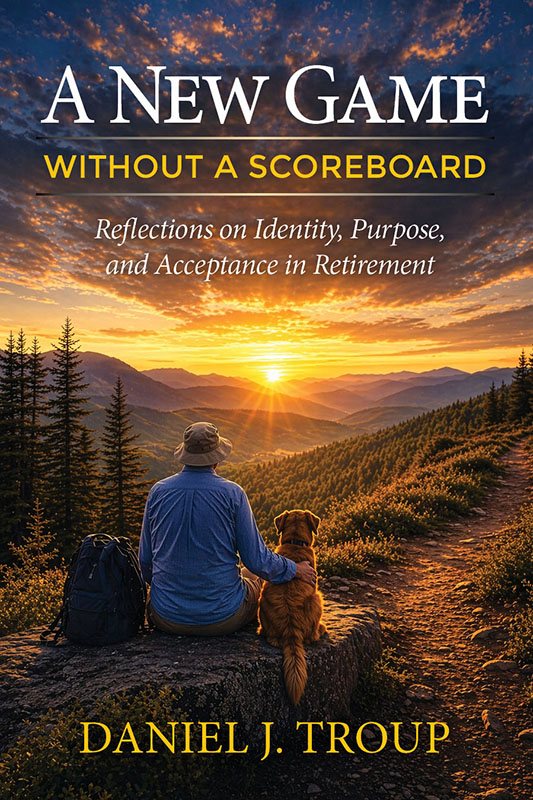
In his newly published book, “A New Game Without a Scoreboard: Reflections on Identity, Purpose and Acceptance in Retirement,” Troup sees that blank stretching way beyond the box into a space where retirees create new words for the “metaphorical road” they travel.
The book is intended as a thoughtful discussion, not a how-to.
“I am not a retirement expert,” Troup’s preface explains. “No Ph.D. No research grants. Just a few decades of experience, a willingness to reflect and a desire to understand this phase of life a little better. Some days I feel like I have things all figured out. Other days, not so much.”
With that appealing dose of humility and honesty, Troup traces his perspective on the personal and societal perceptions of retirement, the uncertainties and the potential to evolve in thoughtfully-evaluated ways. “Permission to experiment,” are Troup’s watchwords.
As a former marketing executive and a career coach, Troup, 66, never spares himself when looking back.
“I always knew who was winning or losing,” he said, adding that he bought into the culture of winning, comparing, measuring and accumulating material possessions.
This is a counterpoint to the new Troup who strives for a life around internal, self-driven values rather than external motives. His ideal now is to “to step away from someone else’s definition of success and begin building your own…. My days don’t have to be full anymore. They just have to be mine.”

To get to that point, Troup followed new kinds of guideposts, but with more fluid boundaries. While the book relays some practical considerations, most of it emphasizes important guiding values in the search for fulfillment.
“Three things pulled me back into view, “ he said. “Identity, community and contribution.”
His personal examples set the tone so that readers can contemplate their own journeys. Reflecting on Identity, Troup goes back to his father’s professional life and retirement, in order to better understand his own.
“I never really knew how my father felt about his experiences. I didn’t ask him the deeper questions. I wanted to be different.” Troup explained community in the context of new connections, which are “not about maintaining old relationships. It’s about rebuilding new ones on your own terms.”
The third value, contribution, goes hand in hand with community. For Troup, it meant taking baby steps at first to move away from paid professional projects and then moving on to more satisfying voluntary community service. He now volunteers his time and his professional background in an organization that offers mentoring with small business owners.
“Sometimes a problem with retirement is you feel invisible,” Troup said. “If you get yourself out in the community, you’re not invisible.”
“I had a lot of twists and turns in the beginning,” he said. “But the great thing about retirement is no one is going to measure what you’re doing.”
That “unfamiliar terrain,” as Troup puts it, also requires a personal compass. He has four points: “health, relationships, contribution and learning.” With those guidelines, Troup’s storytelling and reflections light a pathway for himself and the reader.
The transition had a deep learning curve for Troup. All of his adult life, he thrived in high-achieving environments: undergraduate degree from Cornell University, MBA from the University of Rochester and 30 years as an executive in sales, marketing and leadership, first at Xerox Corporation and then at Nuance Communications, a software company with more than 12,000 employees.
He retired from Nuance nine years ago at age 57.
“A New Game Without A Scoreboard” is his second book. His first was “Selling You: The AdvantEdge Job Search Process,” published in 2021. He also has a blog, “The Sunny Side of 57,” with personal observations that prompt wider reflections for the reader.
Troup’s journey emerged without a task list, a timecard, a job title or a performance review. The airport is no longer the place where he spends all of his time. Instead, he has time to explore more meaningful ways to enjoy his family — his wife, Susan, and his two adult sons, Michael and Steven. He has traded out the conference hall for travels to places like Glacier National Park, where he stood a few years ago awed by the unspoiled grandeur.
It is that kind of transition that both author and readers can embrace.
Troup likes to call the book “a conversation” and sums it up with an encounter he had: “A reader said to me, ‘I feel like you’re speaking to me.’ And that’s what I want the book to do.”
“A New Game Without a Scoreboard: Reflections on Identity, Purpose and Acceptance in Retirement,” published in July, is available in paperback on Amazon.com.
Daniel Troup’s Blog: ‘The Sunny Side of 57’
Reflection on life, family, career, and retirement’
Daniel Troup believes in the power of stories.
He learns and grows through them, and he reaches out to others to interpret his meanings as they will.
Troup started writing his blog “The Sunny Side of 57” three years ago, well before he started his new book, “A New Game Without a Scoreboard.”
Indeed, the blog contains seeds of the material in his book. Troup remarks that, after years of writing for work and for pay, “I started the ‘Sunny Side of 57’ to write and share my thoughts for the pure joy of writing…” The blog postings are short reflections with a photo and a small heading that signals “three-minutes reading.”
“I wanted to inject personality,” he said in my interview with him. Hence, titles like, “Failure on the Road and Learning to Love the Banana Peel” and “When I Was Four, I Didn’t Want to Be Anything. My First Great Forecast.” He takes many of the blog’s photos on his walks; for some posts where he cannot match a personal photo, he goes to ChatGPT, which provides one based upon Troup’s description of the particular post.
Each blog posting is a daily wandering, literally and figuratively, with many observations emerging from his daily walks with his dog, Rigby.
For example, on one such walk, he notices that many people sit in their open garages, where they can see and greet neighbors passing by, rather than being private and invisible in their backyards.
Other posts consider the evolving relationships with adult children, encounters with nature, even airport musings.
Troup aims for two posts per month, and he recently enabled comments on the blog posts, so he can get reader responses.
In response to a post about Troup’s thoughts while walking Rigby, a reader wrote, “Dan, I too have lived those “walk moments”…there is no doubt that our beloved pets can teach us a thing or two (if we let them).”
“It is only through this blog site that I started to discover the joys of writing,” Troup remarks. “My mother, the reading teacher, always encouraged me to write. But I resisted. She would be smiling now if she could see my blog and my book.”
For Daniel Troup’s blog, go to sunnysideof57.com.