

The Legacy of Bill Pomeroy
Entrepreneur has donated millions of dollars after being diagnosed with leukemia in 2004. Doctors had given him about 5% to 10% chance of living two years
By Mary Beth Roach

A diagnosis of leukemia that Bill Pomeroy received in 2004 would eventually lead the founder of the CXtec and TERACAI tech companies to create the William G. Pomeroy Foundation.
And for more than two decades, that foundation has impacted healthcare and history both locally and nationwide.
It has donated millions of dollars but foundation officials didn’t disclose the total amount. In an email, a representative stated that in 2024 alone it had donated more than $4 million.
While he had been a donor to various charities already, Pomeroy said his diagnosis was a pivotal moment. “If the leukemia had not come along, I wouldn’t have been thinking of the foundation at the time.”
Initially, when he received the diagnosis, he was given two months to live if he opted to do nothing. If his first round of chemotherapy led to remission, he would have about 5% to 10% chance of living two years. A treatment for people in remission is a stem cell transplant, but the surgery wasn’t done on individuals older than 60 because it was too difficult, he was told. Pomeroy, now 81, was at that time 61.
With his wife, Sandra, at his side for the duration, Pomeroy underwent a round of chemotherapy at Crouse Health. That first round did not lead him into remission, but a second round did, and it ultimately led him to beginning his foundation to help others battling this disease.
In recalling the ordeal, he said, “This is a terrible experience and everybody that tries to survive this disease goes through this. There’s got to be something to help those that follow me. And I really didn’t know what that was going to be. But I said, ‘I’m going to create a foundation, and I’m going to start funding it, setting aside the money. And once I figure out what we’re supposed to do, then we’ll get busy with it.’”
Between the chemo treatments, he had also visited the Dana-Farber Cancer Institute to learn more about the stem cell transplant, discovering that they had developed a new procedure to help older patients called a reduced intensity transplant — or mini-transplant. He had that transplant done successfully in 2005.
He also learned, while talking with the team from the National Marrow Donor Program, that one’s ethnicity can play a large role in human leukocyte antigen (HLA) typing, which is used to match patients with donors for bone marrow or cord blood transplants. Since HLA types are inherited, the best chance for a suitable donor is someone with a similar racial or ethnic background. While Pomeroy was a perfect match to his donor, finding appropriate matches for people of color can be challenging, since the registry has lacked diversity.
This finding would guide the work of the foundation, Pomeroy said. Numerous bone marrow drives were held and his organization financed others to do recruitment, as well. He said that the foundation has been responsible for recruiting at least 30,000 people to the registry and facilitating more than 300 matches.
The foundation is now shifting its efforts into research, because, as he noted, through research, great strides are being made in improving survivability and matches. Pomeroy and his donor were a perfect match of 12/12. At the time of his transplant, the procedures could be done with a mismatch of perhaps 10/10. Today, research has enabled survivability for patients who have lower mismatch rates, because problems can often be managed effectively, Pomeroy explained.

Expert in IBM Mainframe Accessories
His ability to financially launch the William G. Pomeroy Foundation in 2005 came from his success in the business world.
A graduate of Rensselaer Polytechnic Institute and the Wharton School of Business, Pomeroy had worked for IBM in California in the late 1960s and later in a computer leasing and sales company in Syracuse. Over the years in the industry, he said he found a need that wasn’t being met, and it was on this discovery that he would build his own business.
“I declared myself the expert in IBM mainframe accessories, features, channels and memory,” he said.
In the late 1970s, Pomeroy’s first venture, Reliance Used Computer Corporation, later became CABLExpress and it has become widely known as CXtec. He started out of his home and over the next few decades, he moved the business into space in the Brighton-Ainsley Avenue area in Syracuse and then again into the old Switz’s store in North Syracuse. It would expand; the name would be changed to CXtec and a sister business, TERACAI, would be established. When he retired in 2016, the company had about 300 employees and $100 million in revenue. It has since relocated to the City Center building in downtown Syracuse.

Crouse Health a big recipient
The William G. Pomeroy Foundation’s impact can be seen too on a local level, especially in conjunction with Crouse Health, from naming commitments to support for programs and other initiatives.
“Through personal generosity, corporate leadership and the work of the William G. Pomeroy Foundation, Bill and Sandra Pomeroy have profoundly shaped the landscape of care, education and community wellness at Crouse Health. Their support spans nearly two decades and reflects a deep commitment to advancing healthcare access, honoring caregivers, and investing in the future of nursing,” according to Heather Allison Waters, executive director of the Crouse Health Foundation.
Crouse’s Bill and Sandra Pomeroy School of Nursing is located in Brittonfield in East Syracuse and is a means of showing their appreciation to the Crouse team.
“I had the best nurses you could ever imagine in the world,” Pomeroy said. “Dedicated nurses. Nurses that cared. If it hadn’t been for the nurses, I don’t think I could have made it.”
The Bill and Sandra Pomeroy Treatment Center, on Erie Boulevard East, houses all of Crouse’s outpatient treatment services and programs and the healthcare system operates the largest opioid treatment program in Central New York.
More recently, Pomeroy donated the former CXtec Building on South Bay Road to Crouse and the Pomeroy Center for Community and Wellness, which includes the popular “Visit to Hospital-Land” and spaces for events and educational programs.
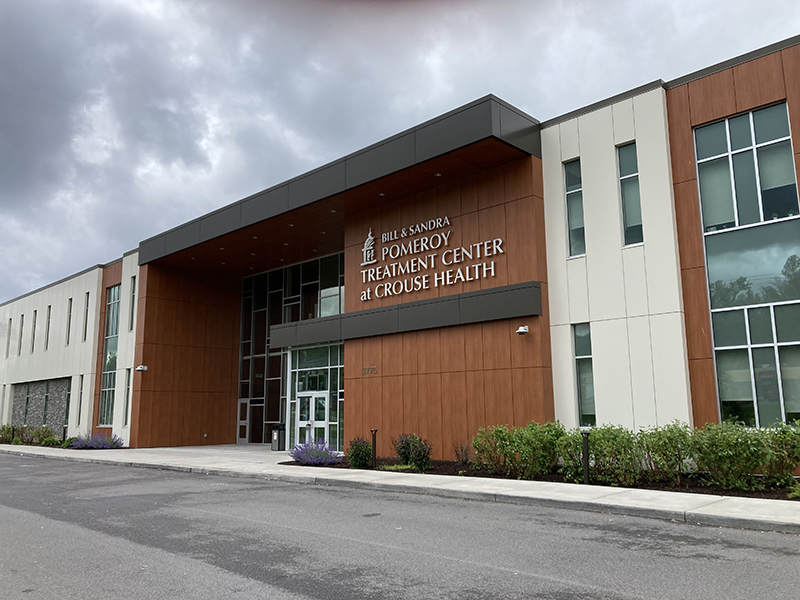 For Pomeroy, he said, it’s “to thank the people that helped me.”
The foundation also provides grants to various healthcare initiatives, community groups, and historical projects. In 2023 alone, according to its website, it awarded more than $3 million.
A portion of those monies went to projects to celebrate local history. It’s a passion that Pomeroy shared with his dad, also named Bill. The family lived in Binghamton and the elder Pomeroy was a manufacturing rep, with Central New York as his territory. His son would often accompany him on these road trips, stopping along the way to visit historic monuments and sites.
“It was just a feature of traveling with my dad,” he said. “And I loved it.”
Probably the most visible examples of the foundation’s involvement in history are the markers that designate historical events and structures. There are more than 2,700 markers in 49 of the 50 states and Pomeroy is planning to further expand the program.
He said that during ceremonies when the markers have been unveiled, “it was extraordinary how these brought people out into the communities, got people talking and got people appreciating their local history.”
Pomeroy continues to help communities celebrate their respective histories and to help foster better healthcare in CNY. Although, his wife, Sandra, died in 2023 from Alzheimer’s, the LaFayette resident continues to develop their legacy.
“I’ve been really building for the future. That’s the way I always think,” he said.
Main Foundation’s Main Initiatives
Increasing the Ethnic Diversity of the Be the Match Registry
One of the main William G. Pomeroy Foundation’s initiatives was to increase awareness and to diversify and grow the Be the Match bone marrow registry so that patients from any ethnic background can find a matching donor. During his battle with leukemia, Bill Pomeroy learned that an urgent need existed to diversify the Be The Match Marrow Registry. His foundation works closely with Be The Match and other organizations to support bone marrow drives in ethnically diverse communities. Since 2008, the foundation has helped organize hundreds of bone marrow drives and registered more than 30,000 people. So far, these drives have produced at least 300 donor-patient matches.
Helping Communities Celebrate and Preserve Their History
Another initiative by the William G. Pomeroy Foundation is focused on historic research, preservation and historic and cultural heritage tourism. The foundation launched its first signage program — the New York State Historic Roadside Marker Grant Program — in 2006 to erect markers at historically important locations in towns and villages within Onondaga County. In 2010, the program expanded to include the New York counties of Cayuga, Cortland, Madison and Oswego as eligible grant recipients. The program then added Erie and Genesee counties in 2011. In April 2012, the program expanded to all municipalities and 501(c)(3) organizations as eligible grant recipients. Since its inception, the foundation has funded over 2,600 markers and plaques in 49 states, all the way to Alaska.