
The Stars Are the Stars of His Shows
By David Figura
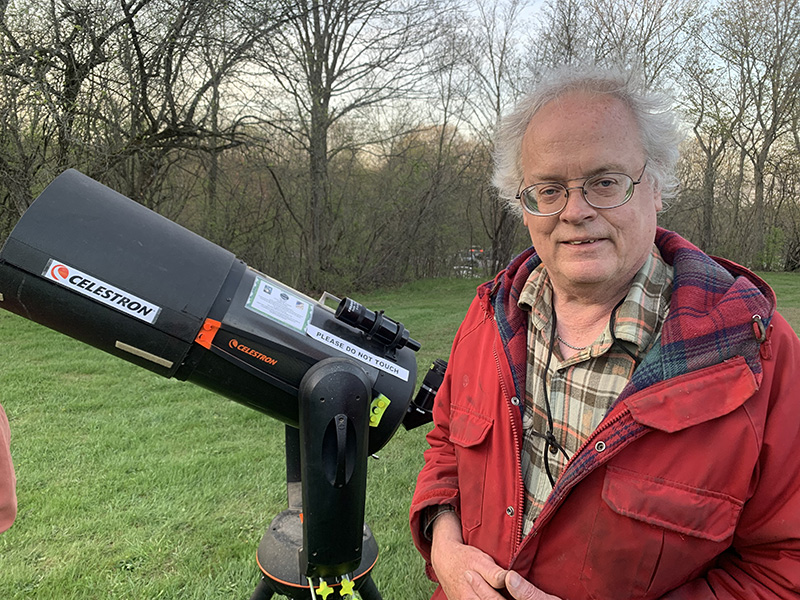
It was a cool, relatively windless April evening at Clark Reservation State Park in Jamesville.
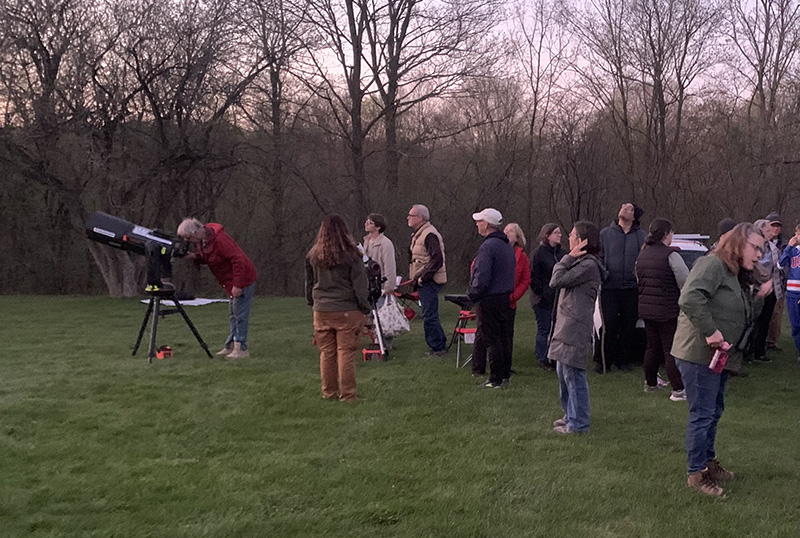
Bob Piekiel, an astronomy expert and author who gives programs at the Baltimore Woods Nature Center and the library in Marcellus and Steve George, his friend and fellow star-gazing enthusiast, were setting up three different types of telescopes and a powerful set of binoculars on an elevated, open grassy area. They were getting ready to lead a two-hour long, astronomy outreach program.
Thirty individuals had signed up for the free event, which was set to begin at 8 p.m. and end at 10 p.m. It was being sponsored by the Friends of Clark Reservation.
“When I book these programs, I look at the astronomical calendar and pick interesting things to look at in the night-time sky,” Piekiel said. “What you can see depends on the time of year. Tonight we’ll be looking at the moon and the planets Venus and Jupiter. And once it gets a little darker around 9 p.m., we’ll look at some deep sky objects like galaxies, nebulae and star clusters.”
He said those present might also see signs of the Lyrid meteor showers with their naked eyes. “It peaks around this time of year,” he said.
Piekiel, 64, of Marcellus, goes by the nickname of “Bare-Foot Bob” due to the fact he often likes to go bare-footed during the warmer months. He said he’s been giving astronomy-related programs at Baltimore Woods and the Marcellus library for 30 years. He has also written 11 books about telescopes on such topics as their types, their history and the do’s and don’ts of taking photographs with them.
His programs have grown in popularity over the years and have also been offered at other libraries, nature centers and parks across Central New York, drawing crowds varying from a handful to a couple of hundred participants. The programs were halted during the COVID-19 pandemic but have since resumed. He said he has 30 scheduled for this year.
 George, 69, of Marietta, first attended one of Piekiel’s programs 10 years ago at Green Lakes. He got hooked and today serves as Piekiel’s sidekick, bringing some of his telescopes and helping out during the programs.
“Between us, Bob and I have about 50 telescopes, some large, some small. Some with special equipment,” he said.
This particular evening, Piekiel brought his large, Celestron telescope with its 11-inch-wide lens, along with a smaller, Svbony refractor scope. The latter, he said, sports “a secret weapon.”
“The refractor scope has a smart eye, an electronic, image-intensifying eye piece. It accumulates and stacks light like a long-term exposure camera would and the result is more color in the image being viewed,” Piekiel said. “For example, a gaseous nebula, viewed straight through a regular telescope lens, looks like a greenish – gray haze. With this smart-eye intensifier, you can see red, green, blue, green … the real colors of the nebula.”
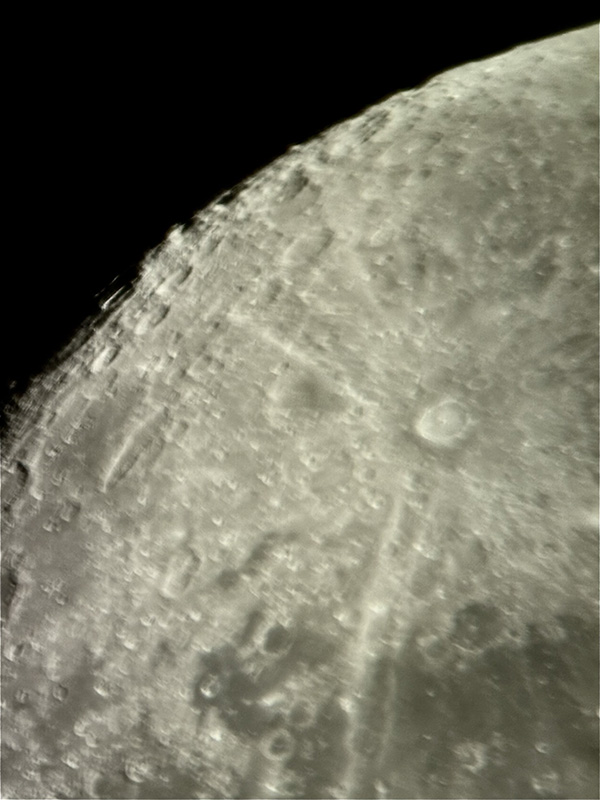
George brought his high-powered, BT-100 binocular scope. Brian Moore, co-chair of the Friends group, was the first to look through it at the moon. “Wow. It’s stunning,” he said.
He was followed by Nancy Vignenult of Jamesville, who likewise was amazed by the close-up image. “I’ve never seen the moon magnified that much,” she said.
George also brought his Stellina, a robotic, rectangular-shaped, “smart” telescope with GPS built into it. It could be programmed using an app on his Android tablet to focus on specific objects or areas of the sky. It then transmits images to the tablet, which can be viewed and downloaded.
“It’s very powerful,” said George, holding the tablet and sharing several eye-opening images from space with those around him. “You can have a little haze in the sky here and there and it can look right through it.”
Meanwhile, others were gazing through Piekiel’s two scopes, gazing at Venus, which was quickly setting and growing brighter by the minute just above a nearby tree line. They also got to view Jupiter, with three of its moons visible.
“In the months ahead, when Venus gets closer to earth in its orbit, it’ll be getting larger and brighter. It’ll put on quite a show in the evening sky,” Piekiel said.
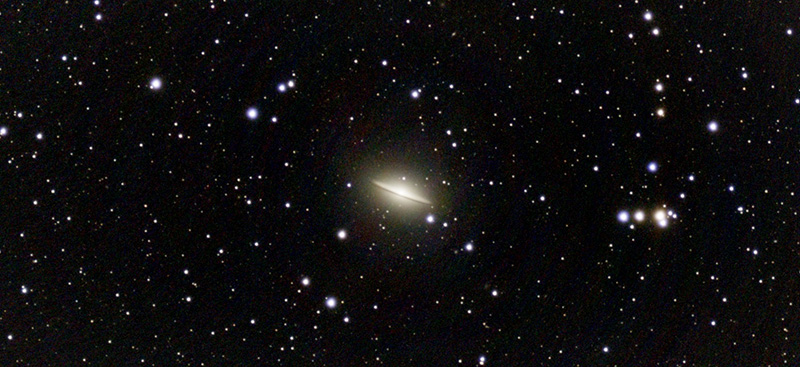
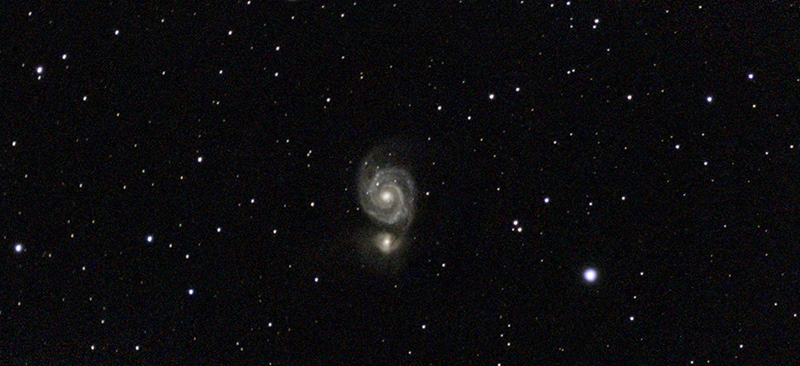
As the evening progressed, Piekiel and George turned their telescopes to focus on deep space objects. Highlights included views of the Pleiades and M-35 star clusters, the Whirlpool Galaxy and the Crab Nebula.
As part of the program, Piekiel used a hand-held, green light laser to point out several bright stars (Sirius, Betelgeuse and the North Star), along with drawing attention to a handful of constellations.
He said the U.S. space station is occasionally visible during his programs at certain times of the year. It orbits the earth every 90 minutes.
“Sometimes if we’re lucky, we’ll see it twice during a program,” Piekiel said.
George said he’s frequently asked if he’s ever seen a real UFO.
“No. I haven’t. But I have seen some weird stuff in the sky. Most things I can explain. Some things I can’t,” he said.
More on Bob Piekiel’s Evening Programs
There is no one web page that lists Bob Piekiel’s upcoming public astronomy/stargazing programs. He leaves that up to the venues and groups that sponsor them.
“I tell them on such and such a date this is what you’ll see in the night sky and they in turn write up their own press releases and put it on their calendars,” he said.
He has programs scheduled for the remainder of this year at Baltimore Woods, the Marcellus Library, Clark Reservation and Green Lakes state parks and Mt. Hope Park. Some are free, others charge a fee. Contact those venues for more information.
Piekiel can be reached at piekielrl@yahoo.com.